
Chapter 3 of Advanced Marketing Techniques, a written course in 14 chapters. The first three are free to read here — no signup. See the full curriculum.
Lesson 3: The Three Stages of the Buyer Journey
Advanced Marketing Techniques • Chapter 03 (Free Preview)
In Brief: The Buyer Journey
The buyer journey represents the psychological evolution of a customer’s mindset. Instead of shouting features at cold prospects, advanced marketers map campaigns across three key phases: Awareness (recognizing a pain point), Consideration (evaluating solution categories), and Decision (selecting a vendor). Aligning your message with their current mindset builds trust, authority, and conversions.
Introduction
For business owners and marketing managers, developing an effective marketing strategy is crucial to long-term success. However, coordinating a modern multi-channel campaign can feel daunting without a clear operational map.
The most reliable way to organize your campaign is around the psychological stages of the buyer journey: Awareness, Consideration, and Decision. By aligning your messaging and delivery channels with the buyer’s mental state, you ensure you provide the right information at the exact time they are ready to receive it.
In this self-guided lesson, we explore the distinct characteristics of each stage, define the exact marketing tactics that convert prospects, and outline the metrics you must track to accurately measure your campaigns.
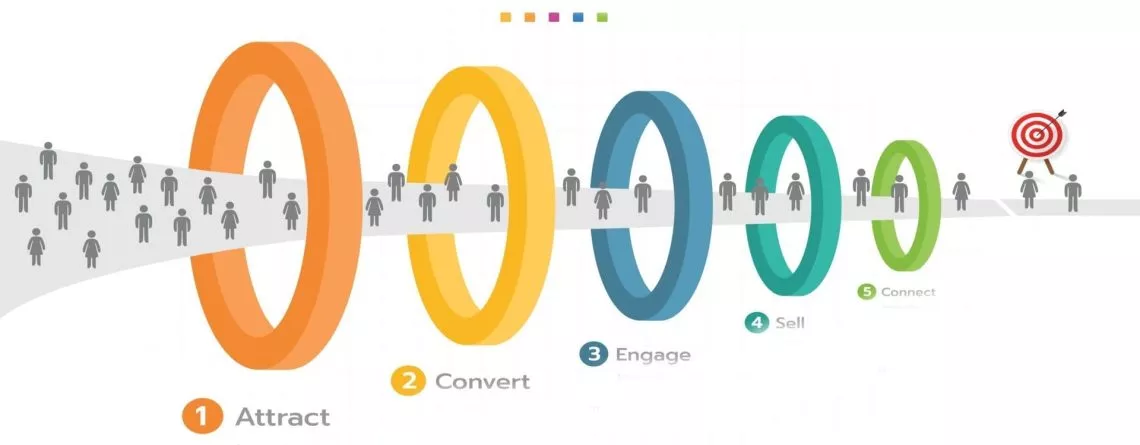
Read the two together: the three stages describe what the buyer is doing, and the five steps describe what you are doing about it. Attract works the Awareness stage, where someone first recognises a problem. Convert and Engage carry the Consideration stage, while they are still weighing options. Sell closes the Decision stage. Connect begins after the sale — and that is where repeat business and referrals actually come from.
The Three Mindsets of the Buyer Journey
To market your product or service effectively, you must understand that the customer moves through distinct psychological phases before making a purchase decision:
| Journey Stage | Buyer’s Psychological Mindset | Practical Example (Skincare / Optical) |
|---|---|---|
| 1. Awareness Stage | The prospect is experiencing symptoms of a problem or need, but has not yet defined it. They are not looking for a brand; they are trying to understand their pain point. | A contact lens brand publishes an article titled: ‘5 Signs Your Eyesight Is Deteriorating.’ This names and validates the buyer’s unspoken problem. |
| 2. Consideration Stage | The buyer has defined their problem and is actively researching available methods and solution categories. | The same brand publishes a comparison guide: ‘Glasses, Contact Lenses, or Laser Surgery: Which Is Best for You?’ |
| 3. Decision Stage | The buyer has selected their preferred solution type (e.g., contact lenses) and is comparing specific vendors, pricing, and trust factors to complete the purchase. | The brand offers a risk-free trial subscription, provides customer reviews, and offers a clear path to checkout. |
By consistently providing high-value educational resources across this loop, your brand becomes a familiar, trusted, and authoritative voice long before the buyer is ready to transact. While some buyers may skip steps based on urgency, most high-value conversions are cultivated steadily over time.
Step 1: Strategies to Drive Early Awareness
To build your audience at the top of the funnel, focus your campaigns on identifying customer pain points across these core distribution channels:
| Awareness Strategy | Operational Best Practices & Workflows | Recommended Tools & Partners |
|---|---|---|
| Content Marketing | Schedule themed editorial calendars (e.g., quarterly themes). Limit direct product pitches to 1 in 8 posts. Focus primarily on ‘Why-based’ education and helpful humor. | Create text, infographics, memes, and video guides on your website blog. |
| Social Media | Publish native, visual content to drive traffic back to your website and increase organic SEO authority. Focus on the platforms where your target demographics live. | Auto-schedule via eClincher Tools or INWWC Business Command Platform (Use code ‘Lesson 3’ for 25% off). |
| Search Optimization | Optimize site speed, mobile-friendliness, alt tags, and modern image formats (WEBP / AVIF). Work on keyword research, technical SEO, and building authority backlinks. | Audit and monitor your site using SEO Growth Software or hire SEO Experts (Use code ‘Lesson 3’ for 25% off). |
| Influencer Outreach | Collaborate with niche micro-influencers whose audiences overlap with your target buyer persona to share educational reviews. | Integrate influencer partnerships directly into your social media workflows. |
| Events & Sponsorships | Host industry webinars or sponsor local community events to introduce your brand story in person to potential buyers. | Deploy public relations support with specialist firms like Indra PR or Pierce Mattie. |
Step 2: Building Trust During the Evaluation Phase
As prospects compare solution categories, your primary goal is to establish deep, unshakeable credibility. Use these five trust-building techniques to secure authority:
| Trust Technique | How to Implement in Your Campaigns | Operational Advantage |
|---|---|---|
| 1. Social Proof | Systematically ask satisfied customers to leave reviews on your website, Google, and independent directories. Showcase case studies. | Reduces purchase anxiety. Contact INWWC Support if you need setup help. |
| 2. Thought Leadership | Publish detailed whitepapers, host free educational webinars, and pursue guest speaker opportunities at local trade shows. | Positions your brand as the industry-standard expert, bypassing pricing wars. |
| 3. Radical Transparency | Make pricing transparent, clarify features, publish robust Terms of Service and Returns policies via Website Policies, and address negative reviews honestly. | Establishes market integrity. Handled correctly, negative reviews can have a proven upside. |
| 4. Personalization | Use customer names in email marketing and run highly targeted birthday promotions on social media platforms to deliver relevant offers. | Increases click-through rates and makes the buyer feel uniquely understood. |
| 5. Responsive Service | Implement rapid-response ticket systems and live chats to answer inquiries or resolve complaints instantly. | Demonstrates that the brand is listening, dramatically boosting consumer confidence. |
Step 3: Closing Sales in the Decision Stage
In the decision phase, buyers are ready to purchase but often require a final, low-friction nudge. Optimize your checkout flow with these four high-conversion tactics:
| Closing Tactic | How to Apply It to Your Checkout Flow | Conversion Outcome |
|---|---|---|
| 1. Time-Sensitive Incentives | Offer an exclusive discount or a value-added package that expires within a specific window. | Triggers healthy urgency and reduces cart abandonment. |
| 2. Bottom-Funnel Social Proof | Place 5-star ratings, testimonials, and quality seals directly on your billing and pricing pages. | Provides late-stage reassurance at the moment of payment. |
| 3. Frictionless Checkout | Limit required checkout fields, provide clear product breakdowns, and accept multiple modern payment options. | Removes technical hurdles, allowing instant payment. |
| 4. Post-Purchase Loops | Follow up with an automated email thanking them, verifying satisfaction, and inviting an honest, incentivized review. | Turns one-time buyers into loyal brand advocates and repeat customers. |
Measuring Success: Key Performance Indicators
To run a highly effective campaign, you must systematically track different data points at each stage of the buyer journey:
| Journey Phase | Core Marketing KPI | What This Metric Measures | Recommended Tool |
|---|---|---|---|
| 1. Awareness | Website Traffic | Total unique visitors to your blog content and educational resources. | Google Analytics |
| Social Engagement | The total volume of social likes, shares, retweets, and comments. | eClincher Suite, Sprout, or others | |
| Content Impressions | The raw number of times your top-of-funnel content was viewed on screens. | Google Search Console | |
| 2. Consideration | Click-Through Rate (CTR) | The percentage of users who clicked an ad, CTA, or comparison guide link. | Ad Managers / Hotjar |
| Lead Generation | The total number of warm opt-ins, form submissions, and template downloads. | CRM (i.e., HubSpot, Zoho / ActiveCampaign) | |
| Email Engagement | The open and click rates of your educational lead-nurturing campaigns. | Email Platform Reports | |
| 3. Decision | Completed Sales & Revenue | The total transactions completed and direct revenue earned from the campaign. | WooCommerce / Stripe |
| Customer Acquisition Cost (CAC) | The total financial marketing spend required to secure a single paying customer. | Excel Budget Formulas | |
| Customer Retention Rate | The percentage of existing customers who return to complete additional purchases. | CRM Tracking Software |
Guiding Your Customer to the Close
Mapping out and executing these distinct stages is critical to ensuring your audience receives the exact, motivating content they require at each milestone.
Recognize that this operational strategy is a marathon, not a sprint. Brand awareness for a high-end consumer purchase can begin years before a buyer reaches the final decision stage. Maintain absolute consistency in your approach. By structuring your content around the three phases of the buyer journey, you build a reliable engine that systematically converts cold prospects into loyal, repeat customers.
How to Build Content for Each Stage of the Buyer Journey
-
Identify Awareness Stage Needs
Create high-level educational content, SEO articles, and social media posts addressing customer pain points.
-
Build Consideration Stage Assets
Offer templates, comparison guides, and calculators that help buyers evaluate solutions.
-
Develop Decision Stage Closing Tools
Provide free trials, direct product demonstrations, pricing pages, and clear CTA incentives.
Need Strategic Support?
If you are ever unsure about a term’s definition or have a specific question about your buyer journey workflows, use our smart chat on the site. If you require hands-on support, please leverage our specialized digital tools or book a free meeting with our consulting team:
| Consultation Link | Strategic Services | Advanced Tools |
|---|---|---|
| Book a Free Consultation → | Explore Services → | Access Tools → |
Ready to Master the Rest?
You’ve just completed the third free chapter of Advanced Marketing Techniques. Unlock all 12 modules, interactive worksheets, custom AI deployment workflows, and budgeting templates now.
That was the last free chapter
Chapters 4 through 14 cover budgeting, the narrative map and brand bible, cohesive branding, tactics versus strategy, social media, metrics and AI — roughly 20,000 words. One payment, no subscription, yours permanently.
Keep reading
- What Is Marketing? The Fundamentals, in Plain English — Chapter 1 — free
- Why vs What: People Buy the Reason, Not the Product — Chapter 2 — free
- Data-Driven Marketing: Harnessing Analytics — From the blog
- Advanced Marketing Techniques — the full course — All 12 chapters, $49